
The real transformation is not faster image generation. It is turning product content from a repeated production expense into a reusable digital system.
Generative AI has made it remarkably easy to create an image.
For global brands, however, creating an image was never really the problem.
The harder problem is creating thousands of commercially usable images and videos while keeping the product accurate, the packaging correct, the language appropriate, the brand consistent and the final asset suitable for television, e-commerce, social media and multiple geographic markets.
Unilever is attempting to solve that problem at the infrastructure level.
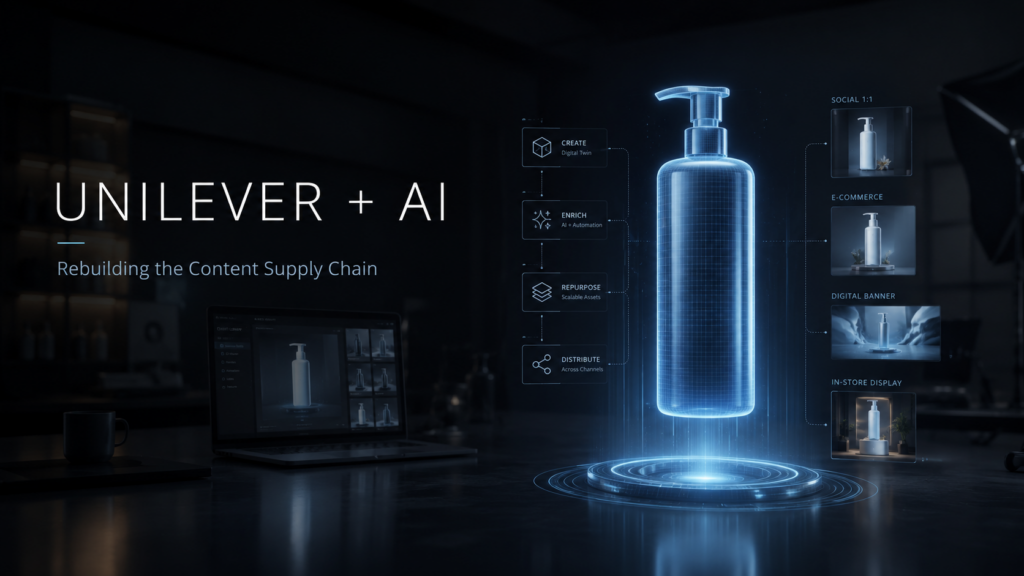
Rather than simply asking generative AI to recreate products again and again, the consumer-goods company has been building highly accurate digital twins of products such as those in the Dove, TRESemmé, Vaseline and Clear portfolios.
These digital product representations can contain approved product variants, packaging, labels and language versions within a common digital asset. Unilever describes this as creating a “single digital truth” for product imagery. (Unilever)
The distinction matters.
This is not primarily a story about replacing photographers with prompts.
It is a story about redesigning the machinery behind global content production.
The hidden problem: one product can require thousands of assets
Consider what happens after a multinational consumer brand launches a single new product.
The same product may need to appear in:
- television advertising;
- retail websites;
- Amazon-style product pages;
- social-media campaigns;
- vertical video;
- display advertising;
- point-of-sale material;
- retailer catalogues;
- different packaging sizes;
- different languages;
- different geographic markets.
Traditional production frequently requires separate shoots, adaptations, agency hand-offs and approval cycles.
NVIDIA’s case study of Unilever describes exactly this problem: social teams, e-commerce teams, creative agencies and regional organisations could require different outputs, while variations in product size, labelling and language could result in thousands of individual visuals. (NVIDIA)
The result is not merely high production cost.
It is duplication.
Unilever says its new approach has reduced duplication across the content process by an average ratio of 5:1. (Unilever)
That figure reveals why this programme is more consequential than another generative-AI experiment.
The company is attacking the underlying production architecture.
Step one: create the product once
The foundation is the digital twin.
In this context, a digital twin is a highly accurate 3D representation of a physical product.
Using technologies including NVIDIA Omniverse and OpenUSD, Unilever and creative technology partner Collective have developed product models that can incorporate different:
sizes
variants
labels
packaging configurations
languages
and approved visual elements associated with the product. (NVIDIA)
NVIDIA says the production process can start with CAD manufacturing data, which is converted into a suitable 3D model. Physically accurate materials and print-ready label files can then be applied to reproduce details such as substrates and metallic finishes. (NVIDIA)
That creates a crucial change in the production model.
Instead of:
campaign → shoot product → create asset → finish campaign
the organisation can move towards:
create verified digital product → reuse it → adapt it → render it repeatedly
The product representation becomes an asset rather than something that must continually be recreated.
That is why the economics change
Unilever reported in March 2025 that product imagery produced through the new digital-twin workflow was being created:
2× faster
and
50% cheaper
than its previous approach.
The company also reported 100% brand consistency for this product-imagery workflow. (Unilever)
Those figures are company-reported rather than independently audited performance measures, so they should be treated accordingly.
But Unilever has also released more granular examples.
For TRESemmé Thailand, the company reported:
- an 87% reduction in content-creation costs;
- content produced twice as fast; and
- a 5% increase in purchase intent. (Unilever)
Across its wider Beauty & Wellbeing implementation, Unilever reported results of:
- up to 55% savings;
- 65% faster content turnaround;
- approximately 2× click-through rate; and
- attention being held three times longer. (Unilever)
These results should not be assumed to apply automatically to every brand, campaign or market.
They are, however, evidence that Unilever is measuring the programme not merely in terms of how many images AI can produce, but in terms of production cost, speed and marketing performance.
Digital twins solve a problem generative AI does not solve well
There is a deeper technical reason this architecture matters.
Generative AI is probabilistic.
Ask an image model to recreate the same shampoo bottle repeatedly and it may alter:
the cap,
the proportions,
the logo,
the lettering,
the reflections,
or small elements of the packaging.
For creative experimentation, that variability can be useful.
For an international consumer brand, it can be unacceptable.
A product shown in an advertisement needs to look like the product consumers can actually buy.
This is where the digital-twin approach is fundamentally different.
The brand does not need the generative model to imagine what the product looks like.
The product already exists as an approved digital asset.
Generative AI can then be used around a controlled representation rather than being responsible for reconstructing the product from scratch.
WPP describes a similar emerging architecture in the industry as combining deterministic 3D product assets, where fidelity is essential, with generative AI for creative contexts and environments where more variation is acceptable. (WPP.com)
That division of labour is important.
Use control where accuracy matters.
Use generation where variation creates value.
That may prove to be a much more durable enterprise-AI model than unrestricted image generation.
From photography workflow to content infrastructure
The change becomes clearer when comparing the two models.
Traditional model
Create brief
↓
Organise product shoot
↓
Photograph individual variants
↓
Retouch
↓
Send to agency
↓
Adapt for markets
↓
Adapt for channels
↓
Repeat when packaging changes
Digital-product model
Create and approve product twin
↓
Store variants and product information centrally
↓
Build scenes and creative concepts
↓
Render different angles and formats
↓
Adapt across channels
↓
Localise
↓
Reuse the same approved product asset
Unilever says its OpenUSD-based approach also enables people working on different production layers to work more concurrently rather than waiting for a strictly sequential workflow. NVIDIA’s Omniverse infrastructure supports real-time collaboration around those 3D assets. (NVIDIA)
That makes the transformation partly about AI, but equally about workflow architecture.
The second layer: generative AI
Unilever has not stopped at digital twins.
Its broader content programme includes generative-AI systems designed to create and adapt marketing assets.
The company’s 2025 Annual Report confirms the launch of a Beauty AI Studio, developed with a technology provider to create content at scale in key markets.
The system is supported by Brand DNAi, which Unilever describes as its global AI brand-governance framework. According to the company, this has accelerated marketing production, lowered execution costs and improved its ability to respond to social-media trends. (Unilever)
Unilever separately reported that its Beauty AI Studio could produce assets up to 30% faster, while key performance measures including Video Completion Rate and Click-Through Rate more than doubled in the deployments it highlighted. (PublicNow)
Again, these are company-reported results from particular implementations—not a general claim that AI automatically doubles advertising effectiveness.
That distinction is important.
But together with the digital-twin programme, they show that Unilever is assembling several technologies into a broader production system:
product data
3D digital twins
brand governance
generative AI
automation
human creative teams
The interesting unit of innovation is therefore no longer the individual AI tool.
It is the content supply chain.
The real advantage may be reuse
The most striking aspect of this model is not necessarily the 50% cost reduction or the 2× production speed.
It is reuse.
A conventional photograph has relatively limited flexibility once it has been produced.
A properly constructed digital twin can potentially be:
rotated,
relit,
placed in another environment,
rendered from another camera position,
combined with another approved asset,
adapted for another format,
and used again for a different campaign.
NVIDIA reports that Unilever’s digital-twin system can also support assets such as 360-degree product views, pours and other dynamic product demonstrations. (NVIDIA)
That changes the economics of the original investment.
The company is not paying only for an image.
It is building a reusable representation of the product.
The same underlying asset can contribute to many subsequent outputs.
Localisation becomes a data problem instead of a reshoot problem
Global brands have another expensive complication: geography.
A bottle sold in Thailand may not carry exactly the same label as the equivalent product sold in Germany.
The pack size may differ.
The language may differ.
Claims may differ.
Local creative requirements may differ.
If these variations exist as approved layers or versions within the underlying digital product system, changing markets no longer necessarily requires recreating the entire product asset.
Unilever says each product twin can hold variants, labels, packaging and language formats within a single underlying digital file. (Unilever)
This is a particularly important point for large organisations.
Scale no longer has to mean simply hiring more people to repeat the same process.
Scale can increasingly mean building systems in which approved components can be recombined safely.
Brand governance becomes part of the technology
This also exposes one of the biggest misconceptions surrounding enterprise generative AI.
The hard problem is often not generation.
It is governance.
A global organisation must answer:
Which logo is approved?
Which packaging version is current?
Which claim can be used in Germany?
Which product shade is accurate?
Which fonts are allowed?
Which language version has been approved?
Which creative has legal clearance?
Which asset is obsolete?
Unilever’s digital-twin system and Brand DNAi programme are attempts to move some of those controls closer to the production process itself rather than relying entirely on people to detect errors after content has already been created. (Unilever)
That does not eliminate the need for human approval.
It changes where governance can occur.
Instead of:
Create everything first, then discover what is wrong.
the more scalable model becomes:
Build approved data, rules and assets into the system that creates the content.
For enterprise AI, that is a major architectural principle.
This is also why “AI creates more content” is the wrong KPI
Generative AI has made volume almost trivial.
A model can create hundreds of images.
That does not mean a business has created hundreds of useful assets.
Each asset may still need:
brand review,
legal review,
product validation,
localisation,
channel adaptation,
rights clearance,
and performance measurement.
The better question therefore becomes:
How much approved, deployable and effective content can the organisation produce?
That is a very different metric.
Unilever Chief Growth and Marketing Officer Esi Eggleston Bracey has explicitly framed the programme in those terms, saying the objective is not simply to push out more content but to combine consumer understanding and creativity with a high-quality content-production system. (Unilever)
The lesson is straightforward:
Generative capacity without production discipline simply creates a larger review queue.
Humans have not disappeared from the model
It is equally important not to overstate what Unilever has automated.
The company’s own communications repeatedly position the technology as a way to give marketers and creatives more time for ideas rather than presenting it as a fully autonomous marketing operation. (Unilever)
The system still depends on people to:
understand consumers,
develop campaign ideas,
define brand strategy,
approve product representations,
judge creative quality,
interpret performance,
and decide what should be published.
The automation is concentrated around activities where machines have a structural advantage:
repetition,
rendering,
versioning,
asset retrieval,
adaptation,
and scale.
That division of work is far more credible than the claim that AI is about to replace the entire creative department.
Unilever is applying the same architectural idea elsewhere
There is another clue that this approach is strategically significant.
Unilever is also expanding digital twins in manufacturing.
Its 2025 Annual Report describes factory digital twins that allow production sites to monitor operations, analyse performance and simulate changes before they are implemented physically. (Unilever)
In June 2026, Unilever announced a multi-year partnership with Accenture to scale AI-enabled digital twins across its global manufacturing network. (Unilever)
The use cases differ—factory simulation is not marketing content production—but the underlying principle is similar:
build a reliable digital representation of something physical, then use software and AI to operate on that representation.
That is much broader than image generation.
What other companies can learn from Unilever
The obvious conclusion would be:
“Companies should create digital twins.”
That is too simplistic.
The deeper lessons are more useful.
1. Standardise before you automate
If product information, packaging, assets and approvals are fragmented, generative AI can multiply the fragmentation.
Unilever first creates an approved digital source of truth.
2. Separate what must be exact from what can be creative
A product package may require near-perfect fidelity.
A campaign background may allow experimentation.
Enterprise AI systems work better when those requirements are treated differently.
3. Treat high-value assets as reusable infrastructure
The economic benefit becomes much greater when something created for one campaign can also serve the next ten.
4. Build governance into the workflow
Brand compliance should not depend exclusively on somebody spotting an incorrect logo at the final approval stage.
5. Measure business outcomes, not AI activity
“10,000 AI images generated” is not a business result.
Cost per usable asset, turnaround time, duplication, CTR, purchase intent and content performance are.
Unilever’s published metrics concentrate heavily on those types of outcomes. (Unilever)
The provocative conclusion: the prompt may be the least important part
Much of the current discussion around AI marketing focuses on better prompts and better models.
Unilever’s experience points towards something more consequential.
For a large enterprise, the competitive advantage may not come from having access to a generative model that competitors can also access.
It may come from what exists behind the model:
proprietary product data,
approved digital assets,
brand rules,
workflow integration,
performance data,
governance,
and the ability to reuse all of it globally.
The AI model can change.
The underlying system remains valuable.
That is why Unilever’s digital-twin programme deserves attention beyond the marketing industry.
It is an example of a broader enterprise-AI principle:
The greatest value often appears when AI is attached to a well-designed operating system rather than added to a broken workflow.
The X3AI perspective
The next phase of enterprise AI will not be defined simply by who generates the most content.
Generation is becoming increasingly accessible.
The harder—and potentially more valuable—challenge is creating the architecture that allows AI-generated work to be accurate, controlled, reusable and scalable.
Unilever’s approach demonstrates what that can look like in practice.
The product becomes structured digital infrastructure.
Brand knowledge becomes governance.
AI provides speed and variation.
Automation removes repetitive production work.
Humans retain responsibility for strategy, creativity and judgement.
That is a more sophisticated model than “AI makes ads faster.”
It is the beginnings of a content production system designed for the AI era.
X3AI — Enabling people and organisations to turn AI into practical value.
Sources and methodology
The core operational figures in this article come directly from Unilever’s March 2025 announcement. Unilever reported product imagery produced twice as fast and at 50% lower cost; a 5:1 reduction in duplication; specific TRESemmé Thailand results; and wider Beauty & Wellbeing results. These are company-reported figures, not independent measurements. (Unilever)
NVIDIA’s detailed Unilever case study documents the technical workflow involving OpenUSD, Omniverse, digital twins, real-time rendering and reusable product variants. NVIDIA is a technology supplier involved in the programme, so its claims should likewise be read as vendor case-study evidence rather than independent research. (NVIDIA)
Unilever’s 2025 Annual Report and Accounts independently confirms within the company’s statutory reporting that it launched the Beauty AI Studio, uses Brand DNAi as its global AI brand-governance framework, and reports faster production, lower execution costs and greater responsiveness to social-media trends. (Unilever)
Unilever’s additional September 2025 disclosure reported asset creation up to 30% faster and more than doubled Video Completion Rate and Click-Through Rate in the Beauty AI Studio cases it highlighted. (PublicNow)
I would use “Unilever Isn’t Just Using AI — It’s Rebuilding the Content Supply Chain” rather than “rebuilding content production.” “Content supply chain” is more distinctive and accurately captures what is interesting here: digital twins + reusable product data + AI + governance + production workflow, rather than merely faster content generation.
Leave a Reply