Unilever: Turning Content Creation into a Scalable System
For years, content creation in global marketing has been treated as a creative exercise. In reality, it has become an operational bottleneck.
Unilever is among the first large-scale companies to confront that reality directly. Its use of digital twins — high-fidelity virtual replicas of physical products — is not just a creative enhancement. It is a structural shift in how marketing content is produced, distributed, and scaled.
At its core, the problem Unilever is solving is complexity. A single product today must exist in dozens of formats: different languages, pack sizes, retail environments, media channels, and campaign contexts. Traditionally, each variation required its own production cycle — new shoots, edits, approvals, and localisation workflows. The result is duplication, cost, and slow execution.
Digital twins collapse that complexity.
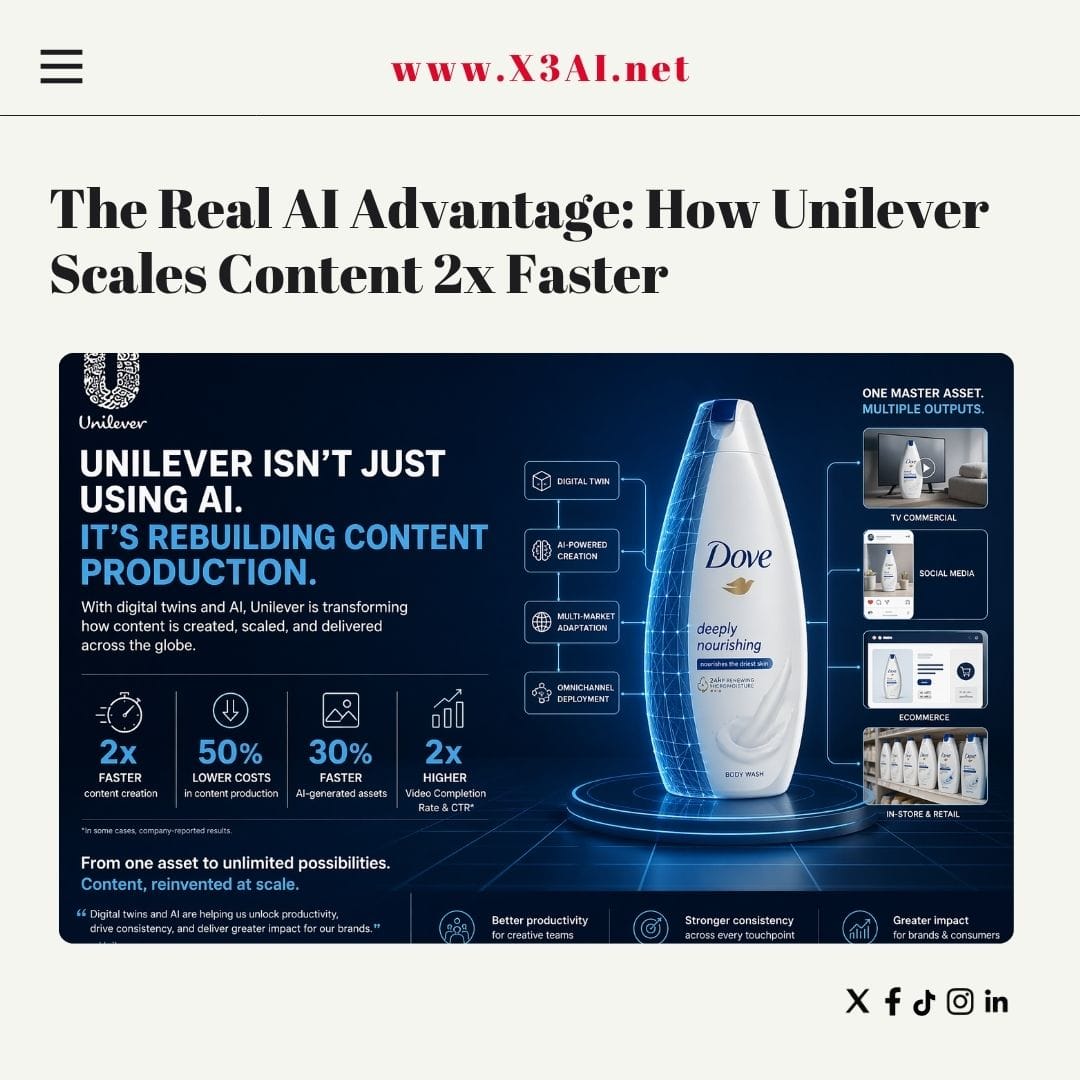
Instead of repeatedly recreating assets, Unilever builds a single, data-rich digital version of a product — a “source of truth” that can be adapted instantly across channels. One asset becomes many outputs. What was once a fragmented production process becomes a modular system.
The operational impact is significant. Unilever reports that product content can be created twice as fast and at half the cost, while also achieving full brand consistency across touchpoints. In some cases, workflows that previously required multiple duplicated versions have been reduced to a single unified asset.
But efficiency is only part of the story.
In a separate AI-focused case study, Unilever highlights that content powered by AI can be produced up to 30% faster, while also improving performance metrics. In certain campaigns, the company reports doubling Video Completion Rates and Click-Through Rates, alongside measurable gains in platform visibility.
These results are worth interpreting carefully — they are company-reported and context-dependent. However, they point to an important shift: better content systems do not just reduce cost; they can improve effectiveness.
This is where the Unilever case becomes strategically interesting.
The company is not simply using AI to generate more content. It is redesigning the content supply chain. By treating assets as reusable infrastructure rather than one-off outputs, Unilever is aligning creative production with the realities of modern distribution — where scale, speed, and adaptability matter as much as creative quality.
That distinction matters. Many organisations experiment with AI at the surface level — generating images, automating copy, testing variants. Unilever is operating one layer deeper: changing how content is built, stored, and reused across the entire marketing ecosystem.
For a company operating at global scale, even incremental improvements compound quickly. With billions of daily consumer touchpoints, gains in speed, cost, and consistency translate directly into competitive advantage.
Key Takeaways
- Content is now an operational challenge, not just a creative one. Unilever’s approach recognises that scale and complexity are the real constraints.
- Digital twins turn content into a reusable system. One high-quality asset can power multiple channels, markets, and formats.
- Efficiency and effectiveness can move together. Faster production (up to 30%) and lower costs (up to 50%) are paired with potential performance gains.
- The real value of AI is structural. The biggest impact comes not from generating content, but from redesigning how content is produced and managed.
- At scale, small improvements compound. For global organisations, workflow optimisation becomes a strategic advantage.