The Real Power of AI in Marketing Isn’t Creation—It’s Control. Coca-Cola Proves Why
The current wave of artificial intelligence in marketing has largely been defined by one capability: content generation.
From images to copy, AI tools promise faster production and lower costs. Yet for global enterprises, the real challenge is not generating content—it is ensuring that content is accurate, consistent, and compliant at scale.
This is where The Coca-Cola Company is taking a different approach.
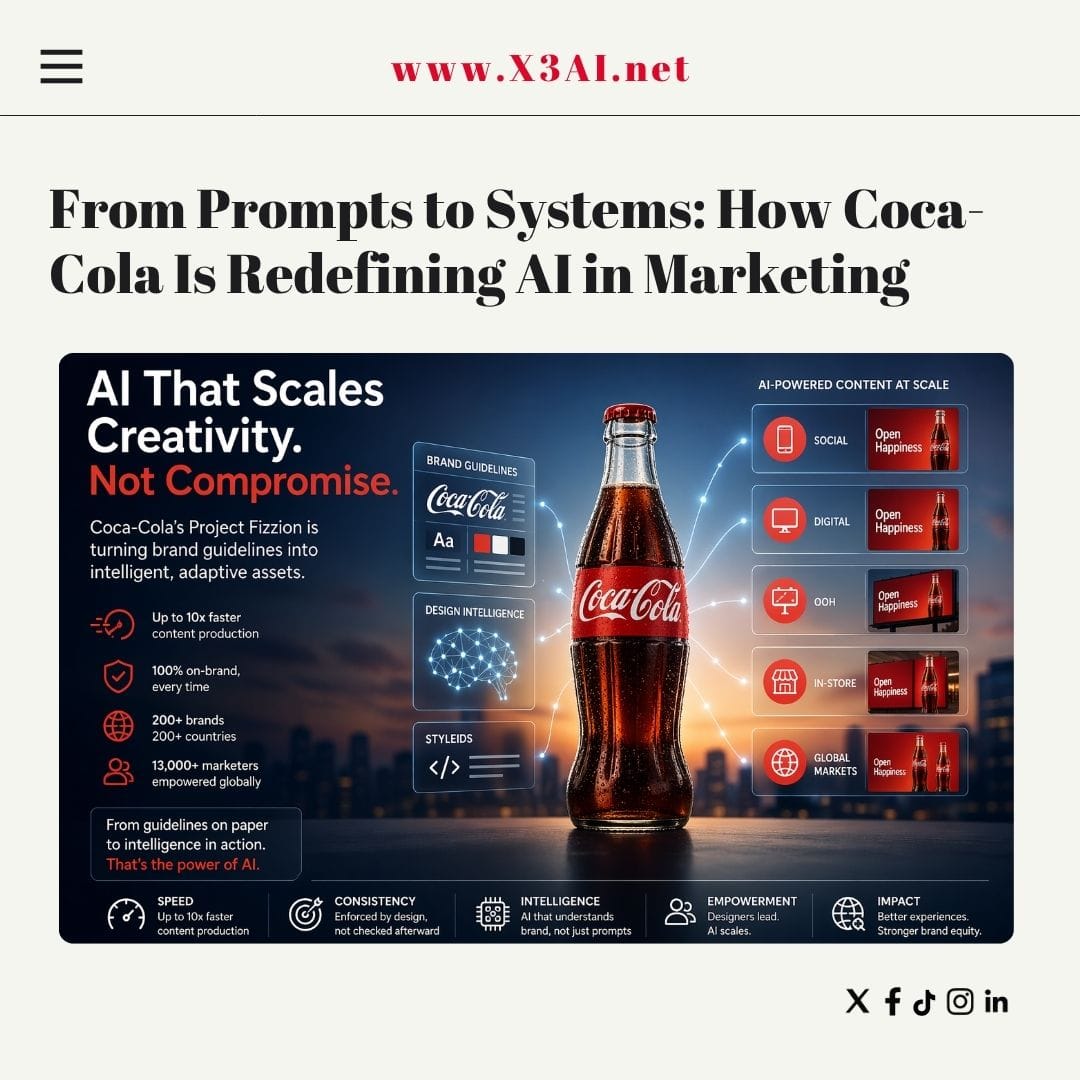
With Project Fizzion, developed in partnership with Adobe, Coca-Cola is not simply using AI to create more content. It is using AI to systematize how content is created, governed, and deployed.
Beyond Generative AI: Encoding Brand Intelligence
Most generative AI systems operate on probability. They produce outputs based on patterns learned from vast datasets, aiming for what looks right.
Coca-Cola’s approach introduces a different paradigm: AI that produces what is predefined to be right.
Project Fizzion transforms traditional brand guidelines into machine-readable logic. Instead of relying on designers and marketers to interpret rules manually, those rules are embedded directly into the system.
Design elements—such as typography, color palettes, layouts, and imagery—are converted into intelligent assets that carry embedded instructions on how they should be used.
The result is a form of AI-constrained creativity, where outputs are generated within clearly defined parameters rather than open-ended prompts.
AI as an Execution Layer, Not Just a Creative Tool
Coca-Cola states that Fizzion enables teams to produce content up to 10 times faster, but the more important shift is architectural.
AI is positioned as an execution layer within the marketing stack.
At scale, the complexity of marketing lies in:
- Adapting assets across formats and platforms
- Localizing content for different markets
- Maintaining compliance with brand and legal standards
These are highly repetitive, rules-based processes—precisely the type of tasks where AI can deliver the most value.
By embedding AI into this layer, Coca-Cola reduces friction not in ideation, but in operational throughput.
From Prompts to Structured Intelligence
A key limitation of many AI deployments is their reliance on prompts. Outputs can vary significantly depending on how instructions are phrased, which introduces inconsistency—particularly problematic for global brands.
Project Fizzion addresses this by introducing structured inputs, including what Coca-Cola refers to as StyleIDs.
These act as machine-readable representations of design intent, allowing AI systems to apply consistent logic across different use cases. Rather than prompting the system each time, teams work with predefined structures that guide output generation.
This marks a transition from prompt-driven AI to system-driven AI.
The Role of Designers in Training AI
Another distinguishing feature of Coca-Cola’s approach is how the AI is trained and governed.
Instead of treating AI as an external tool, designers actively contribute to shaping its behavior. Through Adobe’s ecosystem, creative decisions made during the design process are captured and translated into reusable logic.
This creates a feedback loop where:
- Designers define intent
- AI learns structured patterns
- Future outputs reflect those patterns consistently
In this model, AI does not replace creative expertise; it scales it.
AI at Enterprise Scale: Infrastructure Matters
Project Fizzion is effective because it is not deployed in isolation. It is integrated into a broader content and experience infrastructure that includes:
- A large-scale repository of approved assets
- Thousands of active marketing users globally
- Multi-market, multi-language content operations
This highlights a critical insight:
AI delivers the most value when it is embedded into systems of record and systems of execution, not when used as a standalone tool.
What This Means for AI in Marketing
Coca-Cola’s implementation reflects a broader evolution in AI adoption.
The first phase focused on what AI can create.
The next phase is about how AI fits into systems.
This shift has several implications:
- AI will increasingly operate within constraints, not open-ended generation
- Value will come from consistency and scalability, not just speed
- Organizations will prioritize integration over experimentation
- Competitive advantage will depend on how well AI is embedded into workflows
Key Takeaways
- The Coca-Cola Company is using AI to structure and govern content creation, not just generate it
- Project Fizzion represents a shift from prompt-based AI to system-based AI
- The primary value of AI at scale lies in execution, adaptation, and consistency
- Machine-readable constructs like StyleIDs enable predictable, controlled outputs
- AI’s long-term impact in marketing will be defined by its role in infrastructure and workflows, not standalone tools