
AI’s Great Divide: Why Breakthroughs Race Ahead While Business Reality Crawls
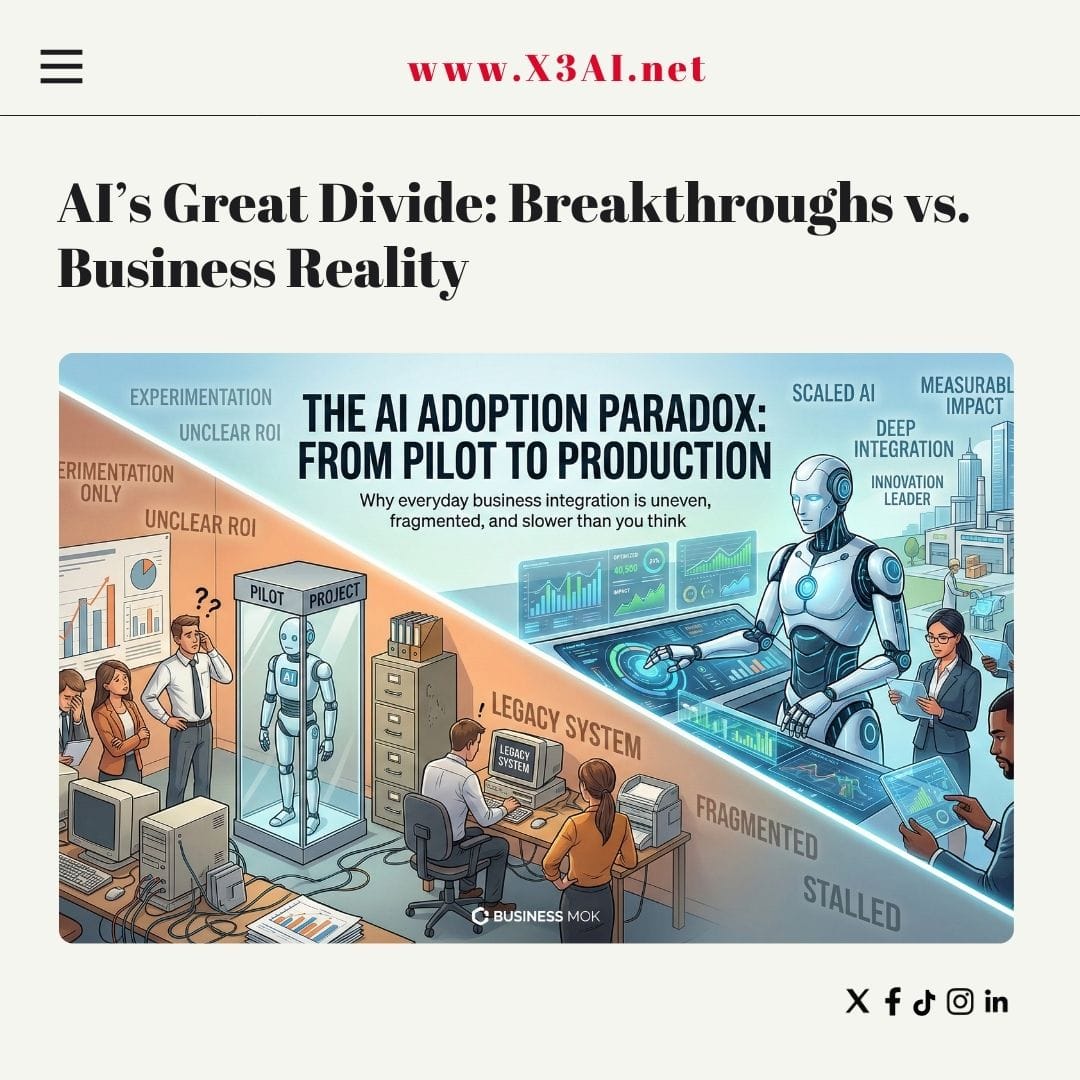
Artificial intelligence is advancing at a breathtaking pace in research labs and tech giants — yet across everyday business operations, adoption remains uneven, fragmented, and often disappointingly slow. The result is a widening gap between what AI can do and what most organizations actually deploy at scale.
The Paradox: Ubiquity Without Depth
On paper, AI looks nearly universal. Roughly 78% of companies now use AI in at least one business function, and adoption has surged dramatically since 2023. (aiprm.com)
But breadth is not the same as transformation.
Only a minority of firms have integrated AI deeply across operations. In fact, fewer than one-third of organizations in some regions have moved beyond pilot projects to full deployment, despite heavy investment. (Consultancy ME)
Many initiatives stall in experimentation — impressive demos that never become mission-critical systems.
Even when deployment occurs, measurable impact is elusive. A major consulting study found only about 5% of companies achieve substantial financial benefits from AI, while most see little or no return. (Business Insider)
Leaders and Laggards: A Sectoral Split
AI adoption varies dramatically by industry.
Knowledge-intensive sectors — technology, finance, healthcare, and professional services — dominate implementation efforts. (secondtalent.com)
Manufacturing has also accelerated, with roughly 77% of manufacturers adopting AI, particularly in production and inventory management. (GPTZero)
At the other extreme, physical and low-digitization sectors lag badly. Construction adoption, for example, has been measured as low as 1.4%, highlighting how operational complexity and thin margins slow transformation. (Salesmate)
Even within organizations, adoption is uneven across functions. Customer service, analytics, and marketing often move first, while core systems like finance, supply chain, or enterprise resource planning remain resistant due to risk and integration challenges.
Pilots Everywhere — Production Nowhere
A defining feature of the current AI era is the “pilot trap.” Organizations experiment widely but struggle to scale.
Worker access to AI tools has surged — increasing by roughly 50% in a single year — yet production-level deployment still lags behind expectations. (Deloitte)
Meanwhile, many companies lack the infrastructure to operationalize AI effectively. Reports indicate that the vast majority of pilot projects fail to deliver measurable ROI, not because the technology is inadequate, but because organizations are unprepared to integrate it into workflows. (Axios)
Legacy systems are a major obstacle. Large enterprises often run on decades-old platforms that cannot easily support modern AI capabilities, and executives widely fear outdated technology will constrain adoption for years to come. (TechRadar)
Geography Matters Too
The unevenness extends beyond industries to entire economies.
Generative AI usage now reaches about one in six people globally, yet adoption grows far faster in wealthier regions. (Microsoft)
High-income countries dominate recent gains, widening the gap with developing economies.
Even within advanced nations, leadership in AI research does not guarantee widespread use. Infrastructure, policy, skills, and accessibility all shape real-world uptake.
Organizational Maturity Beats Technology
One of the clearest findings across studies: success depends less on tools and more on organizational readiness.
Companies with mature processes, strong data foundations, and coordinated leadership consistently outperform others. For example, organizations with advanced DevOps practices report far higher success rates in integrating AI than less mature peers. (IT Pro)
The most effective adopters treat AI not as a plug-and-play upgrade but as a full transformation of workflows, decision-making, and skills.
Why Operational Functions Lag
Several structural barriers slow adoption in core business operations:
- Legacy IT and technical debt that cannot support modern AI systems
- Data quality and governance issues
- Regulatory and risk constraints, especially in finance and healthcare
- Skills shortages and workforce resistance
- Unclear ROI and accountability
- Complex integration with mission-critical processes
In short, deploying AI in a chatbot or analytics dashboard is easy; embedding it into payroll, procurement, logistics, or safety-critical systems is not.
The Emerging Two-Speed Economy
What is emerging is not universal transformation but a two-tier landscape:
AI-native organizations
Deep integration, measurable gains, competitive advantage
AI-curious organizations
Isolated tools, stalled pilots, minimal impact
Startups are often pulling ahead of incumbents because they build AI into products from the outset rather than retrofitting legacy systems.
The Bottom Line
AI is not failing — but diffusion is uneven. The technology frontier is sprinting while operational reality walks.
The companies that will dominate the next decade are not necessarily those inventing new models, but those capable of embedding AI deeply into everyday processes. Until organizations solve integration, governance, and cultural challenges, the gap between AI’s promise and its practical impact will persist.