AI Assistants Compared: Grok vs ChatGPT vs Perplexity vs Google Gemini
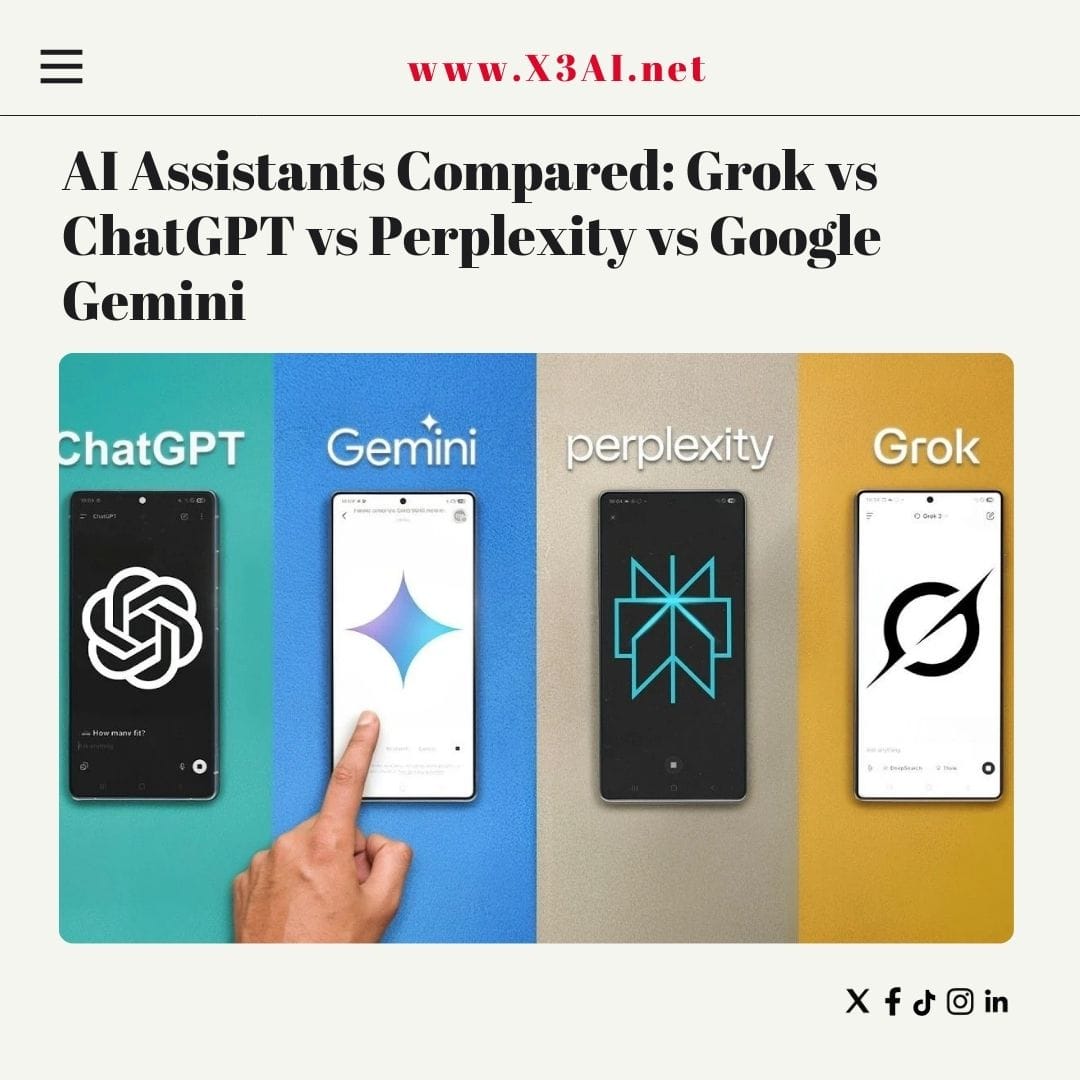
Artificial intelligence assistants are no longer experimental tools — they are becoming daily work companions. Yet not all AI models are built for the same job.
While Grok, ChatGPT, Perplexity, and Google Gemini are often grouped together, they differ significantly in design philosophy, data access, reliability, and use cases. Understanding those differences is critical before choosing which one to rely on.
This article compares them based strictly on documented capabilities and observed behavior, not hype.
1. ChatGPT (OpenAI): The Generalist Powerhouse
Primary focus: Reasoning, writing, coding, analysis, and structured problem-solving.
ChatGPT is designed as a multi-purpose cognitive assistant. It excels at synthesizing information, following complex instructions, and producing structured output such as reports, code, strategies, and explanations.
Strengths
- Strong logical reasoning and multi-step analysis
- High-quality writing and editing
- Excellent programming and debugging support
- Works well for long-form content and complex prompts
- Supports tools such as data analysis, file handling, and image understanding
Limitations
- Does not automatically browse the web unless explicitly enabled
- Knowledge may lag behind real-time events without browsing
- Less focused on instant source citation by default
Best for
- Professionals
- Developers
- Writers
- Analysts
- Strategic or technical tasks
Summary:
ChatGPT behaves like a highly capable digital consultant — not just an answer engine, but a thinking partner.
2. Perplexity AI: The Research and Citation Specialist
Primary focus: Real-time search with sourced answers.
Perplexity is fundamentally different from other assistants. It acts more like an AI-powered research engine than a conversational model.
Its defining feature is automatic citation of sources, typically pulling information directly from live web results.
Strengths
- Real-time web access by default
- Clear citations for nearly every claim
- Fast fact-checking and verification
- Strong for current events and news
Limitations
- Weaker reasoning depth
- Limited creativity and long-form writing
- Less capable with complex logic or multi-step tasks
- Responses can feel fragmented due to search-based assembly
Best for
- Journalists
- Students
- Researchers
- Fact verification
- Market or trend lookups
Summary:
Perplexity answers “What is true right now?” better than anyone — but struggles with “What does this mean?”
3. Google Gemini: The Ecosystem Integrator
Primary focus: Integration with Google products and multimodal AI.
Gemini is deeply embedded into Google’s ecosystem — Gmail, Docs, Search, YouTube, Maps, and Android.
Rather than competing purely on reasoning, Google positions Gemini as an AI layer across its services.
Strengths
- Tight integration with Google Workspace
- Strong multimodal processing (text, image, video, audio)
- Excellent at summarizing YouTube videos and documents
- Native access to Google Search
Limitations
- Inconsistent reasoning quality across tasks
- Less reliable with complex logic
- Output quality can vary depending on context
- Conservative response behavior
Best for
- Google Workspace users
- Everyday productivity tasks
- Document summarization
- Cross-app workflows
Summary:
Gemini is less of an independent thinker and more of a smart operating system assistant.
4. Grok (xAI): The Real-Time Social Intelligence Model
Primary focus: Live data from X (formerly Twitter) and informal analysis.
Grok is built by xAI and tightly integrated with the X platform. Its key differentiator is direct access to real-time social discourse.
It is designed to interpret trends, conversations, and breaking narratives as they happen.
Strengths
- Real-time access to posts on X
- Strong awareness of trending topics
- Informal, conversational tone
- Useful for social sentiment analysis
Limitations
- Information quality depends heavily on user-generated content
- Weaker academic or structured reasoning
- Less suitable for professional documentation
- Limited external verification
Best for
- Trend monitoring
- Social media analysis
- Public sentiment tracking
- Cultural commentary
Summary:
Grok answers “What are people saying right now?” — not necessarily “What is accurate?”
Side-by-Side Comparison
| Feature | ChatGPT | Perplexity | Gemini | Grok |
|---|---|---|---|---|
| Core strength | Reasoning & creation | Live research | Ecosystem integration | Social trend awareness |
| Real-time data | Optional | Yes | Yes | Yes (via X) |
| Source citations | Limited | Strong | Moderate | Weak |
| Writing quality | Excellent | Moderate | Good | Casual |
| Coding & analysis | Excellent | Weak | Moderate | Weak |
| Best use case | Deep work | Fact-checking | Productivity | Trend insight |
The Key Difference: Philosophy
The most important distinction is not technology — it is intent.
- ChatGPT is built to think with you
- Perplexity is built to verify for you
- Gemini is built to work across Google for you
- Grok is built to reflect the internet’s pulse
No single model replaces the others.
They solve different cognitive problems.
Final Verdict
If you want:
- Deep reasoning, writing, or coding → ChatGPT
- Live facts with citations → Perplexity
- Productivity inside Google tools → Gemini
- Real-time social awareness → Grok
The smartest users increasingly do not choose one — they combine them, using each AI where it performs best.
In the AI era, the advantage is not which model you use —
it is knowing which model to use for which question.